Terrestrial Carbon Storage
Vast amounts of carbon are stored naturally in the earth’s ecosystems. Factors that influence how much carbon is stored include land management decisions, timber harvest intervals, and impacts of wildfire.
Land management practices can be altered to sustainably increase live biomass and store more carbon. Examples include reforesting cleared or mined lands and conserving stands of large trees. Harvested trees can be used to produce long-lasting products—such as high-quality building materials and furniture—that can keep captured CO2 from re-entering the atmosphere (via decomposition or fire) for many years.
Another strategy is to reduce CO2 emissions from forest fires. Forests that are choked with brush, invasive plants, or an unhealthy number of small trees can be managed by removing these materials for renewable biomass power production. This approach could potentially control the severity of wildfires and the associated ecological damage, loss of forest resources, and pollutant emissions. Electricity from biomass power plants also displaces fossil fuel use for power generation, which decreases overall CO2 emissions.
One of the attractions of terrestrial carbon storage is the potential for significant environmental, economic, and aesthetic co-benefits. These may include:
- Improved forest health
- New wildlife habitat
- Reduced soil erosion and stream sedimentation
- Stronger local economies
- Reclamation of poorly managed soils
- Improved recreational opportunities
Terrestrial storage also offers the opportunity for broad participation in climate change solutions. Many carbon offset programs rely on forest-based terrestrial storage projects. |
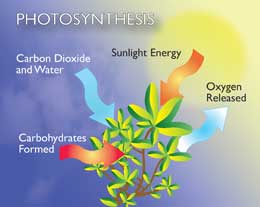
During photosynthesis, plants convert CO2 and water into carbohydrates to use for growth. This process fixes carbon in plants, organic matter, and soil. |
